This week’s Sylvia GM Windows x64 alpha is available. The main additions are prepared parties for four existing adventures, clearer GM and Builder activity, and a fix to how the app handles shutdown.
Four easier starting points
From Home, you can preview A Debt in Iron, Last Cart Through, The Cartographer’s Wake and Rift Awakening, each with a prepared party. These are existing Severed Lands adventures, not four newly written stories.
Starting one creates an independent, editable campaign. If you want to change the party first, Customize saves editable copies and takes you through the normal Campaign Interview. Loading a prepared party is still separate from connecting a model and getting the GM’s first narrated response.
Clearer activity and Builder guidance
GM and Builder now distinguish live work from completed, stopped and failed attempts, with a compact View activity history. Builder also has clearer workflow prerequisites and navigation through complete bounded source pages.
This build includes a shutdown fix too. Incomplete or refused shutdown is reported rather than treated as a clean exit.
Dictation, the twelve individual starters, Riichi Mahjong and earlier continuity fixes remain included from alpha.2. They are not new additions this week.
Download and update
Download alpha.3 and read the release notes. The release has an unsigned Windows installer and a portable ZIP, plus the Windows installation guide and SHA256 checksums.
The installer and portable ZIP are unsigned Windows x64 downloads and require Microsoft Edge WebView2. Back up your campaigns, close Sylvia before updating, and follow the installation guide. For the portable version, extract the whole ZIP to a writable folder and keep its adjacent isolated-data folder with your saved data. Updates are manual for this release.
Narrated play needs a compatible model provider; hosted services may charge for usage. ChatGPT account connections also require the supported separately installed Codex runtime. Whisper transcription weights are not bundled.
Sylvia itself is free and source-available, with use restrictions and additional permissions described in the supplied licence files. Included content and dependencies keep their own terms. Full setup, tested-scope and redistribution details are in the release notes.
A lot happening behind the scenes
There’s a lot of exciting stuff in the pipeline now. If you’ve been using Codex lately, you’ll probably understand how the extra resets have affected my ability to stick to one project. Naturally, I’ve had a few side projects going, but I’ve also been getting a lot of groundwork done for bigger additions to Sylvia.
Two of those are getting particularly interesting: a much better frontend, and Trigger Discipline, an original ruleset built specifically with Sylvia in mind.
These are upcoming additions, rather than features I’m claiming are all included in this alpha update. There’s already substantial working code behind them, though. They’re well past the “wouldn’t it be cool if…” stage.
1. Sylvia’s new frontend
I caved and tried Opus to see what it would come up with, with relatively little direction from me. The result was already much better than my original frontend, which was essentially Sol interpreting my own scribbled design sketches.
So I’m swallowing my pride and letting it take the wheel on the design direction. I knew it had a reputation for being better at frontend design, but I underestimated how much of a difference it would make on this particular project.
The biggest improvement is how the interface uses your screen. There are three switchable views:
- Board: gives the map and game panels the space, with the conversation folded into a narrow rail. Useful when you’re concentrating on positioning, equipment and the current situation.
- Balanced: keeps the game panels and conversation side by side.
- Story: gives the conversation more room while keeping the essential game information nearby.
You can also adjust the divider yourself. The idea is that the interface should suit what you’re doing at that moment, rather than making you fight one fixed arrangement throughout an entire campaign.
The navigation is cleaner too. One expandable rail replaces the old sidebar arrangement, including access to your Builder sessions while you’re playing. The panels themselves have had attention, rather than just receiving a nicer border: character information, equipment and ammunition, network status, map controls and queued actions have a more consistent visual hierarchy.
It’s easier to distinguish the conversation from something you’ve queued up, or an ally from a hostile or a device. Information that belongs together actually looks like it belongs together.
This is already a working implementation, not just a pretty mockup. There’s still integration and testing to finish, but I’m much happier with where it’s heading. The underlying goal hasn’t changed: keep the default experience straightforward, while making the deeper controls available when you want them.
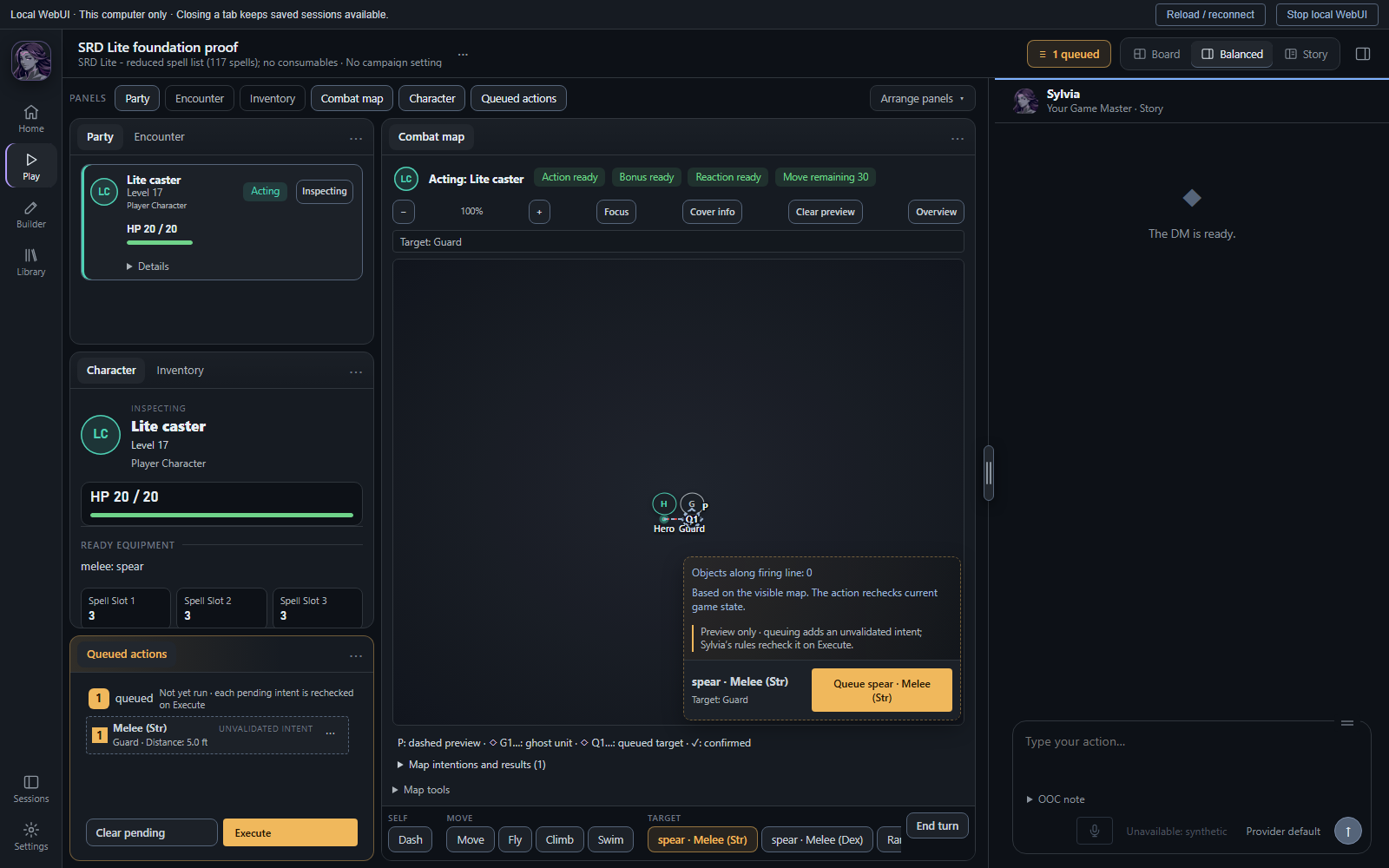
The upcoming frontend with SRD Lite: character information, combat map and queued actions in the Balanced view.
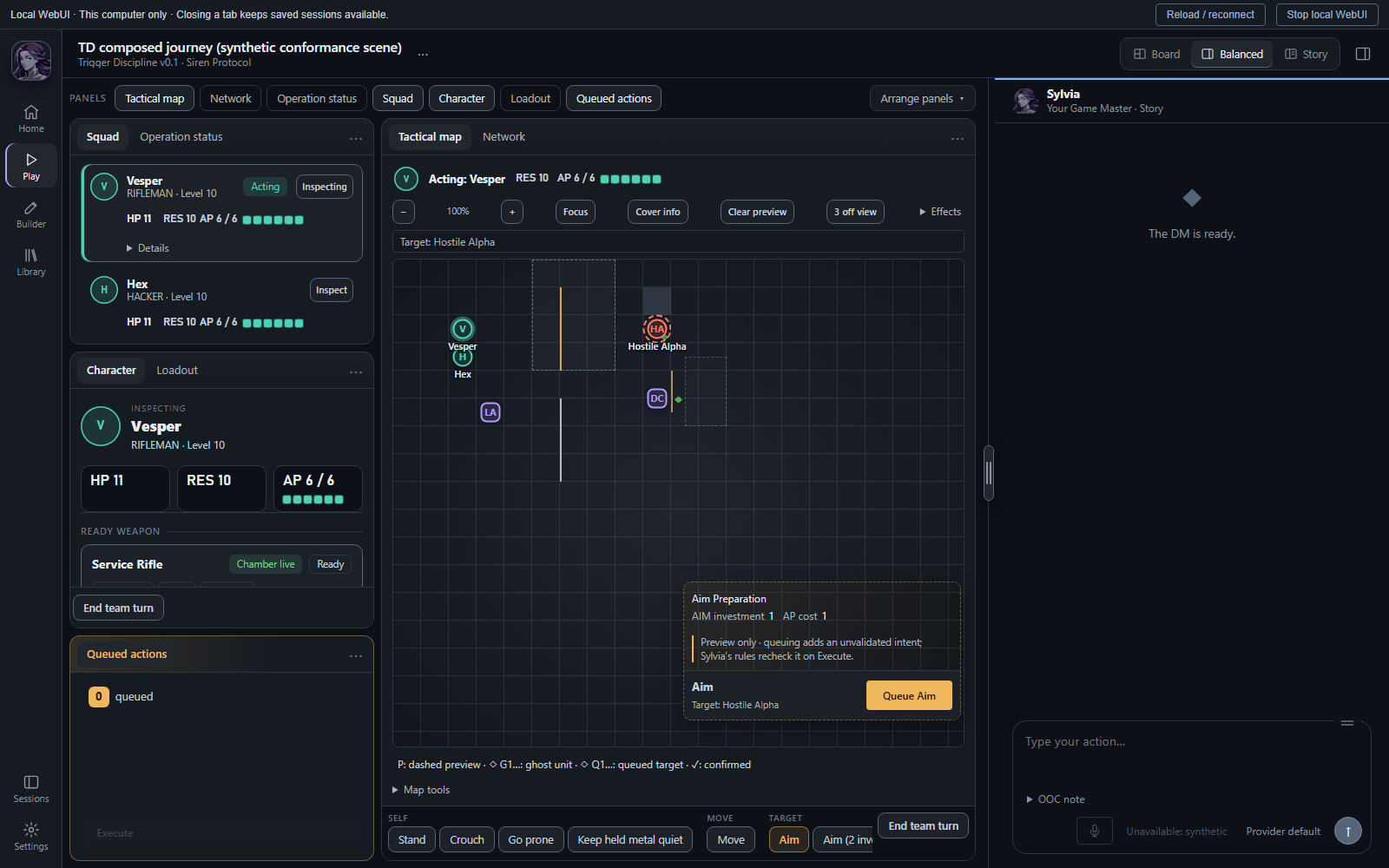
The upcoming frontend with Trigger Discipline: squad, equipment and tactical-map panels in the same Balanced view.
2. Trigger Discipline
Trigger Discipline is a reusable, original ruleset for Sylvia, focused on tactical gunplay. It also includes drones, hacking, close-quarters combat, stealth, casualty treatment and social influence, so there’s considerably more to it than picking a gun and comparing damage numbers.
Positioning is a big part of the design. Cover takes physical shape, stance, angles and exposure into account. Suppression is active fire that uses ammunition and makes exposure dangerous, rather than being interchangeable with overwatch. Recoil, ammunition and reload decisions matter. Allies can alternate actions during their team’s turn while spending their own action points, giving you room to coordinate rather than rigidly finishing one character before touching another.
There are nine classes, but learned skills aren’t locked to them. Progression is intended to give you more options and capabilities, rather than turning an ordinary person into someone who can absorb increasingly ridiculous amounts of gunfire just because their level went up.
This is a good example of what I find exciting about building a ruleset for Sylvia first, rather than designing a pen-and-paper game and then asking the software to imitate somebody reading its rulebook.
At a physical table, every extra calculation has a cost. How often do players need to look something up? How much arithmetic are they doing? How much of the session disappears into resolving an action?
With Sylvia, the computer can handle that bookkeeping. I still need to make the rules understandable, interesting and worth playing, but I don’t have to reject a useful mechanic simply because resolving it by hand would be miserable.
I want tactical depth without accidentally making the next Campaign for North Africa, where resolving everything becomes a larger commitment than the campaign itself.
That opens up a really interesting space: some of the simulation and tactical decision-making you’d expect from a turn-based videogame, combined with the freedom of a tabletop RPG to attempt things the designer didn’t explicitly put on a menu. You can build a different world, change the premise, or take a campaign in a direction I never anticipated.
That’s the ambition, anyway. Making the computer do the calculations doesn’t automatically make every mechanic good, so testing and balancing still matter.
Siren Protocol
Trigger Discipline will come with a premade setting, Siren Protocol: a female-dominant cyberpunk dystopia set on Earth in 2225, roughly two centuries after an event called the Severance radically changed human birth patterns.
The first developed region is future Sydney and its surrounding coast. Powerful corporations, surviving government and local communities all compete for influence and control. It isn’t simply one corporation owning the entire world, and it isn’t built around one mandatory protagonist or a prescribed story.
The setting gives you a world to make campaigns in. What you do with it is up to you.
Trigger Discipline itself isn’t tied to that future, either. I have at least one more setting in the works that uses a modern-day backdrop instead of science fiction, so look forward to that too.
Why this matters for Sylvia
The frontend is the immediately visible improvement, but Trigger Discipline is also a practical demonstration of the broader idea behind Sylvia: reusable rulesets, settings and campaigns that don’t all have to look or play like the same game.
I want the groundwork we’re doing now to make the next interesting idea easier to build, rather than having to start from scratch every time.
For this alpha update, I’m keeping the release focused on what’s actually ready. The larger additions are coming through separately, and I’ll show more as they become ready to put in your hands.